
Insight
Should You Take the Builder’s Rate Buydown? A Straight Answer for Texas Buyers

If you are shopping new construction in Texas right now, you have almost certainly been offered a builder rate buydown. And if you have gone looking for advice about whether to take it, you have probably noticed that most of what you find is written by someone whose job is to tell you the builder is hiding something.
We are a builder. And we would rather just explain how this works.
What a rate buydown actually is
A buydown means someone pays money upfront to lower your mortgage interest rate. When a builder offers one, the builder is paying that cost as an incentive to close the sale. There are two versions, and the difference between them matters more than the headline rate.
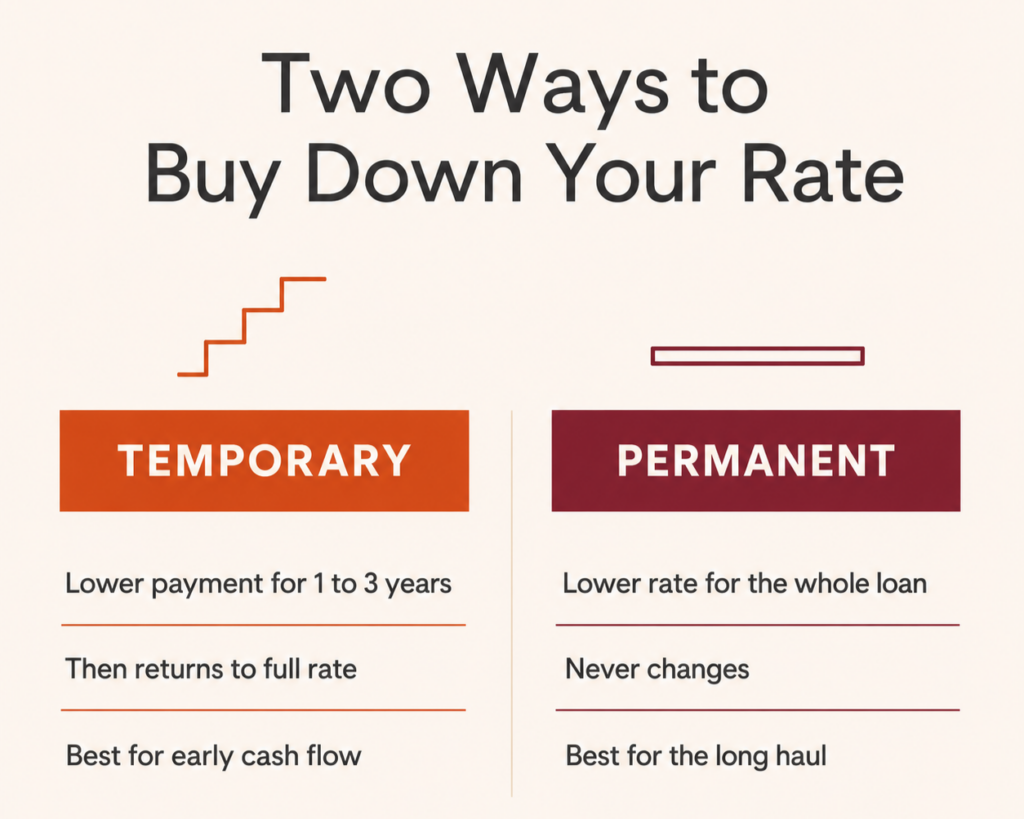
A temporary buydown lowers your rate for the first one to three years, then it reverts to the full note rate. You will see these written as 2-1 or 3-2-1, meaning the rate is reduced by two percentage points in year one and one point in year two, and so on. The money funding it sits in a buydown account and is released monthly to cover the difference.
A permanent buydown uses discount points to lower the rate for the entire life of the loan. One point costs one percent of the loan amount, and the rate reduction you get for it varies by lender, loan type, and market conditions. The monthly savings are smaller than a temporary buydown’s first year, but they never go away.
Both are real money. They are simply structured for different problems.
The question that actually decides it
Rather than asking which buydown is better, ask what your real constraint is. There are three common ones, and they point in different directions.
If your constraint is cash at closing, a temporary buydown or a closing cost credit does the most for you, because it frees up money in the window when you are most stretched.
If your constraint is long-term affordability, a permanent buydown is usually the stronger choice. Chasing the lowest first-year payment is the wrong move if the payment in year four is the one that worries you.
If your constraint is qualifying at all, talk to your lender before you get attached to a number. This is the one that catches people. On most loan types you are underwritten at the full note rate, not the temporary reduced rate, so a temporary buydown may not increase what you can qualify for even though it lowers what you pay at first.
Four things worth checking before you decide
- Know when the payment changes, and confirm you are comfortable with it.With a temporary buydown, write down what the payment becomes in the year it fully reverts. If that number makes you uneasy, the incentive is solving the wrong problem. This is not a reason to avoid a temporary buydown; it is a reason to choose it deliberately.
- Understand the preferred lender condition.Most builders, including us, tie their financing incentives to a preferred lender. That is standard, and it exists because the builder can only guarantee terms it has an arrangement to deliver. It is also a fair thing to test. Ask an outside lender for a quote with no incentive and compare the total cost, not just the rate. Sometimes the incentive wins comfortably. Sometimes it is closer than you expect. Either way, you will make the decision with information instead of assumption. Our preferred lender is Mission Mortgage of Texas (NMLS #207583).
- Compare total cost, not monthly payment.Monthly payment is the number everyone quotes and the number that hides the most. This is also exactly what the Consumer Financial Protection Bureau recommends: ask a loan officer to show you two options, one with points or credits and one without, and to calculate the total costs across a few different timeframes. A five-year picture will separate two offers that look identical on a flyer.
- Ask what else is on the table.Financing incentives are one line item. Closing cost contributions, design selections, and lot considerations are others. Ask about the full package rather than negotiating against a single number.
On timing
Builders do respond to the calendar; ends of quarters and ends of years tend to be when incentive packages are most active. That is worth knowing. It is not worth building your entire timeline around, especially in a community with limited inventory, where waiting for a better offer can cost you the specific home you wanted.
The honest summary
A builder rate buydown is not a trick, and it is not free money. It is a real incentive with a specific shape, and the right question is whether that shape matches your situation. A buyer worried about cash today and a buyer worried about their payment in five years should not choose the same package, even in the same community, even on the same house.
One last thing if you are new to the state. The tax and insurance portion of a Texas monthly payment surprises almost everyone arriving from elsewhere, and it will affect these calculations more than the buydown does. Our guide to moving to Texas covers what to expect.
If you want to walk through the math on a specific home, we will do that with you, including the version where the answer is that you should keep looking.
This article is general information about how builder financing incentives are structured. It is not financial advice. Your lender can model these scenarios against your actual numbers.
Want to run the numbers on a specific home?
We will walk through the full monthly payment and the total cost, not just the headline rate.